TIG operates on an Optimizable Proof of Work (OPoW) concept in which benchmarkers are rewarded in proportion to their Proof of Work, whilst being incentivized to balance different factors evenly during the PoW process.
The forthcoming Sigma Update protocol redesign adjusts how those rewards are calculated. Both self‑deposit and delegated‑deposit now feed into the influence metric, so benchmarkers must balance their deposits as well as their challenge output. Because the deposit required is determined by the market rather than synthetically fixed, there’s no mandated minimum stake. Moreover, since we weight the deposit factors as well as cap them we protect against the protocol becoming proof of stake. The proposed mechanism is an added defence against Sybil attacks.
Benchmarker Rewards
Benchmarker rewards are in essence calculated in the same way, benchmarkers are rewarded for the amount of computational work they do, as well as how well that work is balanced. The total rewards distributed for proof‑of‑work done by benchmarkers is a fraction \text{BM%} of the total block reward:
Each benchmarker i receives \text{benchmarker_reward}_i from a block (before delegator deductions), where
The term \text{influence}_i represents how much proof‑of‑work benchmarker i has performed and how well they have balanced their factors. Before giving the explicit formula for influence, we detail the factors used to calculate it. There are two types of factors: challenge factors and deposit factors. Factors are recalculated each block.
Challenge Factors
Challenge factors have been decoupled from reliability, the factor is now just based on the number of qualifying solutions a benchmarker gets. Challenge factors are derived from individual challenges. For each challenge x, benchmarker i has an associated challenge factor calculated using their qualifying solutions:
Here \text{num_qualifiers}_{i,x} is the number of qualifiers benchmarker i has for challenge x in the current block, and \text{total_qualifiers}_x = \sum_i \text{num_qualifiers}_{i,x}. If there are currently n challenges, then each benchmarker has n challenge factors—one for each challenge.
Deposit Factors
Deposit factors are derived from TIG deposits. Each benchmarker i has
- a self deposit factor \text{self_deposit_factor}_i, determined by their own deposit, and
- a delegated deposit factor \text{delegated_deposit_factor}_i, determined by deposits delegated to them.
They are calculated as follows:
Note that \langle\text{challenge_factor}_i\rangle =\frac{1}{n}\sum_x \text{challenge_factor}_{i,x} is the average of the challenge factors and measures how actively a benchmarker is participating in the current block. The \min function caps a benchmarker’s deposit factor based on their challenge performance, this stops the protocol from becoming proof of stake.
Here
- \text{self_deposit}_i is the amount of TIG that benchmarker i has deposited,
- \text{delegated_deposit}_i is the amount of TIG delegated to benchmarker i through the delegated deposit mechanism, and
- \text{total_deposit} and \text{total_delegated_deposit} are the total deposits and delegated deposits of all benchmarkers whose cutoff is non‑zero.
Influence
To calculate the influence of a benchmarker i, the following steps are performed:
- Collect the set of factors for benchmarker i : \{f_j ~:~ f_j ~\text{is a factor for benchmarker }i\}. Let \hat f_i be the vector of these factors.
- Compute weights w_j, and attribute each factor f_j with a weight w_j. The weights are normalised. The weights are the same for all benchmarkers.
- Compute the weighted mean \langle \hat f_i \rangle and variance \sigma^2_i of the factors of benchmarker i. Set \mathcal{S}_i=\frac{\sigma_i^2}{\langle \hat f_i \rangle (1-\langle \hat f_i \rangle )}.
- We then set the influence of benchmarker i to be:
Note: In the above formula:
- k is a constant currently set to 1.5.
- The exponential term is bounded in [0,1].
- As \mathcal{S}_i increases, the benchmarker is penalized for their imbalance, no variation means the exponential term takes the value 1 and the benchmarker is not penalized.
- The term \mathcal{S}_i is bounded in [0,1]. For a fixed mean \langle \hat f_i \rangle, the maximum of \sigma_i^2 is \langle \hat f_i \rangle(1-\langle \hat f_i \rangle), hence \mathcal{S}_i measures the spread of the data relative to its mean.
- Weighting lets us:
- Onboard new challenges smoothly.
- Weight Deposit Factors differently from Challenge Factors.
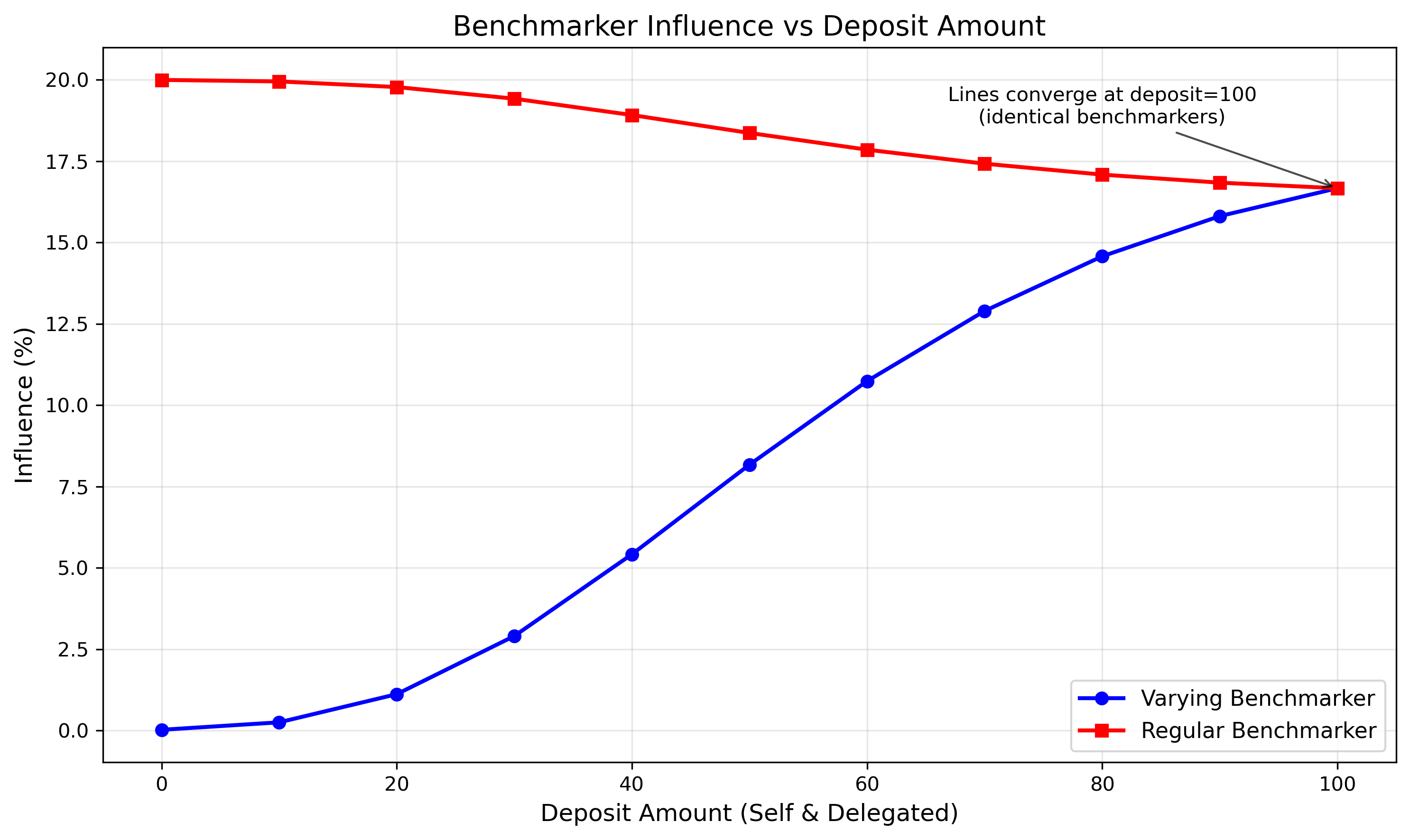
Figure 1 – Influence vs deposits for six benchmarkers with equal qualifiers.
Five maintain deposits of 100 while one varies from 0 to 100. The plot shows convergence to equal influence (16.67 %) when all benchmarkers become identical. Deposit weight = 0.1 highlights the protocol’s performance‑focused reward mechanism.